The "Goldilocks" Dilemma: Designing the Perfect Ring for the Medium Activity Client
By Christel Davel, Owner & CAD Designer, Everallure Jewelry
In my last post, we explored the P.A.C. Method (Profile, Aesthetics, Customization)—my 3-step framework for designing engagement rings that last a lifetime. We often talk about the extremes: the Low Activity Client (who works a desk job and removes their ring instantly at home) and the High Activity Client (the rock climber, the ER nurse, or the Crossfit enthusiast).
But what if you are somewhere in the middle?
Enter the Medium Activity Client. You are the most common client I see, yet you are often the most difficult to design for because your life requires a perfect balance of delicacy and durability.
Here is how we apply the Art & Engineering of the P.A.C. Method to design a ring that can keep up with you.
Who is the "Medium Activity" Client?

You aren't scaling mountains every weekend, but you aren't sitting still either.
Your Lifestyle: You might be a teacher, a busy parent, a doctor, or a creative professional. You’re constantly using your hands.
Your Habits: You wear your ring most of the day—grocery shopping, typing, cooking dinner, walking the dog, and maybe during a light workout (though I always recommend taking it off for weights!).
Your Risk: You are prone to the "accidental knock"—banging your hand against a doorframe, reaching into a purse, or catching a prong on a sweater.
For you, a super-high "peg head" setting is a snagging hazard, but a full bezel setting might feel too chunky. You need the Goldilocks Design: secure enough to live in, but open enough to sparkle.
Step 1: P is for Profile (The Engineering)
For the Medium Activity Client, the Profile Height is the single most critical decision.
The Mistake: Choosing a high-set solitaire where the diamond sits entirely on top of the band. This is a magnet for knocks and snags.
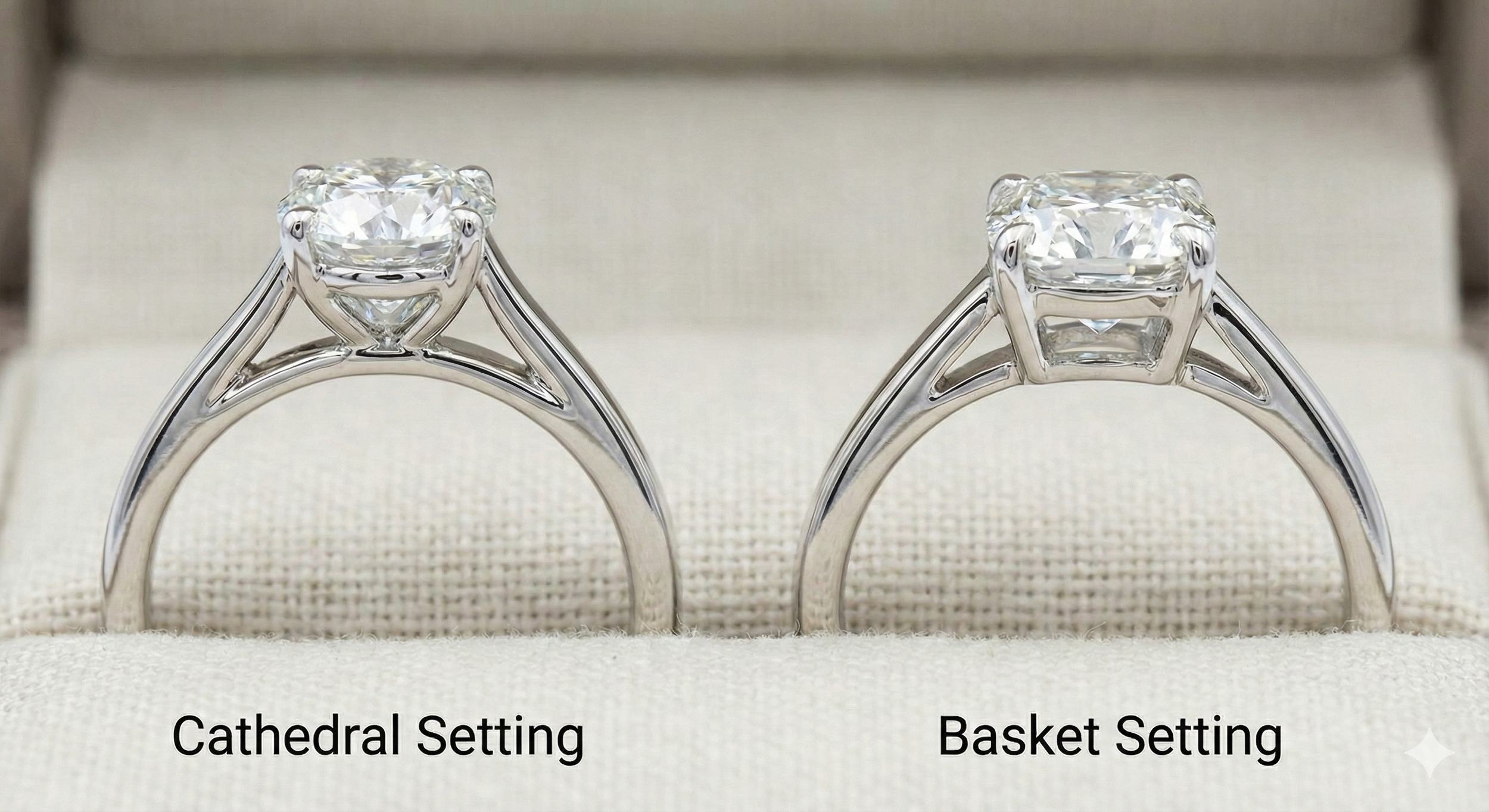
The Solution: A Cathedral Setting or a Basket Setting.
Why? These designs incorporate metal "shoulders" or a gallery rail that rises up to meet the diamond. This doesn't hide the stone; it acts as a structural shock absorber. If you knock your ring against a table, the metal takes the impact, not the prong or the diamond.
The Non-Negotiable Stats: Even for a medium activity level, we never compromise on the foundation.
Shank Width: Minimum 2.0 mm.
Shank Thickness: Minimum 1.8 mm at the base.
Designer’s Note: A 2.0mm band is still considered "dainty" and elegant. Going thinner (like the 1.5mm bands you see online) effectively turns your ring into a wire that will bend under the pressure of carrying groceries or gripping a steering wheel.
2. Aesthetics (The Art): Six Prongs Are Better Than Four
The Move: Upgrade from a standard four-prong setting to a Six-Prong Setting.
Why it’s a Hybrid: A four-prong setting leaves the corners of your diamond vulnerable. If one prong breaks, the stone is gone. A six-prong setting adds two extra points of contact, creating a much more secure "basket" for your diamond. It also gives a round diamond a beautiful, star-like appearance.
Metal Choice: Platinum is your best friend. It’s denser and stronger than gold, meaning it holds onto those prongs tighter and longer.